


Richard Hunt at University of Chicago

The artistic odyssey of sculptor Richard Hunt (1935–2023) is intricately woven into the intellectual, geographical, and architectural landscape of the University of Chicago (UChicago). Across a relationship that spanned more than seven decades, evolving from a high school employee to a master sculptor of international renown, the university and its surrounding neighborhood served as a vital crucible for Hunt's creative vision.
Hunt holds the unique distinction of remaining the only non-white public sculptor with art permanently displayed across the University of Chicago campus. From his early engagement with biological sciences to his monumental outdoor installations, Hunt translated UChicago’s Gothic architecture, scientific resources, and emblematic iconography into a radical visual language of direct-metal abstraction.
%208.jpg)
Chicago Roots and Aesthetic Transformation
Richard Hunt’s connection to UChicago began in his early childhood. Born on September 12, 1935, in a modest bungalow on South Eberhart Avenue in West Woodlawn, Hunt was born just blocks from the southern edge of the university campus. Navigating the rigid racial boundaries of segregated Chicago, he viewed the university as both an immediate boundary and a space of intellectual refuge. This geographic proximity placed Hunt at the crossroads of pivotal American history:
-
Proximity to Emmett Till: Emmett Till lived merely two blocks away from the Eberhart Avenue home where Hunt was born.
-
Witness to Tragedy: In the late summer of 1955, while working at UChicago's zoological laboratory and taking university night classes, the 19-year-old Hunt attended Emmett Till’s open-casket funeral. Hunt is recognized as the only major visual artist known to have attended the service in person. Hunt completed Hero’s Head (1956) in response to having been a firsthand witness to what became the spark that ignited the Civil Rights Movement. Learn more about Hero's Head.
-
The Imperative of Ascension: Encountering the horror of racial violence firsthand deeply shaped Hunt's artistic mission. Rather than resorting solely to figurative depiction, Hunt channeled this visceral confrontation into an artistic commitment to metamorphosis. Hunt refused to let raw metal remain inert or broken, and instead breathed life into heavy, industrial steel and bronze, creating forms of fluid movement, organic growth, and spatial ascension.
Biological Foundations and Industrial Salvage
While studying at the School of the Art Institute of Chicago (SAIC) and taking foundational art classes at the nearby South Side Community Art Center (SSCAC) under figures such as Margaret Burroughs, Hunt supported himself between 1951 and 1957 by working as an animal caretaker and laboratory technician in UChicago’s Zoological Experimental Laboratory. This environment provided several foundational pillars for his mature aesthetic:
-
Biomorphism: Daily contact with animal biology and skeletal structures allowed Hunt to internalize how nature engineers movement. This directly gave rise to his biomorphic language, a fusion of biological and mechanical elements, as seen in early works such as Organic Construction, Number 10 (1961), and Winged Hybrid Figure, Number 3 (1965).
-
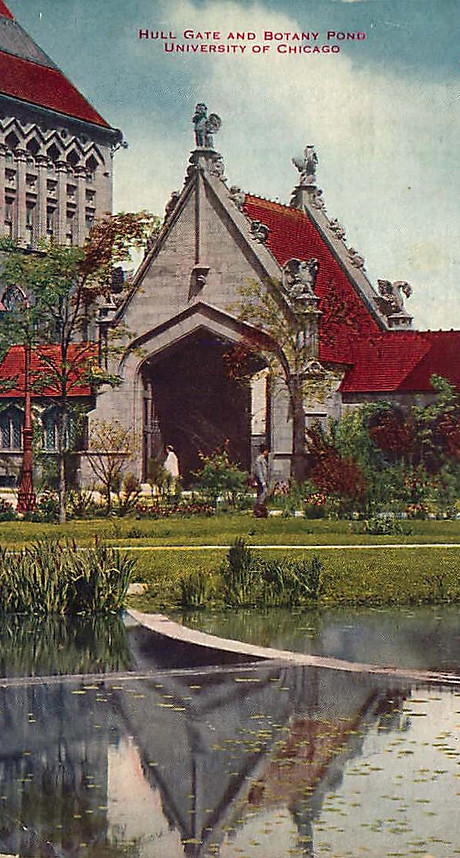
Botany Pond: Adjacent to the laboratory, Botany Pond served as a field study site. Hunt’s early welded masterpiece, Construction A (1956), was directly inspired by the Pachydiplax longipennis (blue dasher dragonfly) inhabiting the pond’s ecosystem.
-
Campus Assemblage: Hunt routinely scavenged discarded office and laboratory equipment from university basement cleanouts. Most famously, the bulging, expressive eyes of his breakthrough sculpture Arachne (1956), which was acquired by the Museum of Modern Art (MoMA) when Hunt was just 21, were fabricated from the splayed steel shades of two discarded UChicago goose-neck desk lamps.
-
Architectural and Intellectual Synthesis: Daily walks through Gothic landmarks such as Cobb Gate, with its medieval winged gargoyles, combined with biology classes and his job at the zoological laboratory, fueled Richard Hunt’s interest in mythology, history, and physical science.

Connections to the University of Chicago
The central visual element of the University of Chicago is the phoenix, featured on the institutional coat of arms alongside the motto Crescat Scientia, Vita Excolatur (“Let knowledge increase so that life may be enriched”). The mythical firebird, rising from its own ashes, became a defining motif within Hunt’s practice. For Hunt, the concept of metamorphosis operated as both an artistic technique and a cultural metaphor:
“The phoenix has come to signify a race of people who rise from destruction and are vigorous enough to start anew.”
— Joseph A. Bailey, II, M.D.
By subjecting rigid metal to intense heat and reforming it into soaring, open-form dynamic structures, Hunt mirrored the resilience and transcendent spirit of the African American experience.

Public Art at the University of Chicago
As Hunt’s practice expanded into large-scale public commissions, UChicago became home to major sculptures that bookend his monumental career.
Why? (1974)
Commissioned in memory of UChicago professor Samuel Nerlove, Why? is a sweeping, 12-foot cast-bronze sculpture designed as a physical metaphor for academic inquiry. Originally sited on the lawn of Harper Quadrangle, the sculpture greeted generations of students and faculty daily.
The sculpture was later transferred to the permanent collection of the Smart Museum of Art, where it is displayed at the museum's west entrance. The work also forms an intercollegiate bridge, with editions of Why? displayed at Northwestern University, Chicago and University of California, Los Angeles.
%20Large.jpeg)
Becoming (1974)
Installed in the courtyard of the Disciples Divinity House (DDH) near the end of his life, Becoming is a welded bronze sculpture created in Hunt’s Lill Avenue studio. The bronze sculpture honors the shared legacy of brothers and former DDH Scholars, James E. and Thomas V. Stockdale.
Funded by University Christian Church in Seattle to honor Jim Stockdale's decades of ministry, Hunt's ascending metalwork was commissioned by Tom Stockdale’s family following his passing in 2016. Connected by a shared history around the University of Chicago's biological laboratory and classes the three took together in the 1950s (Hunt and the Stockdale brothers), both the artist and the two late ministers spent their lives dedicated to the arts, community outreach, and transformative faith.
Reflecting his lifelong engagement with sacred and ecumenical spaces, the work captures what Hunt described as a continuous conversation between metal’s structural strength and its capacity for expressive fluidity.

Leadership and Legacy
From his youth scavenging desk lamps to his monumental bronzes permanently sited on campus, Richard Hunt transformed the physical and intellectual environment of the University of Chicago, forging a legacy defined by freedom, transformation, and artistic triumph.
Hunt’s institutional relationship with UChicago matured beyond his artistic contributions. From 1977 to 1997, he served on the university’s Visiting Committee on the Visual Arts, actively guiding its collection policies and cultural direction.
Final Resting Place
Richard Hunt is interred at Oak Woods Cemetery, located just south of the university in Woodlawn, alongside his wife, Lenora Cartright. His grave will be marked by Spirits Ascending, a 22-foot welded bronze monument based on one of the final maquettes Hunt designed prior to his passing in 2023.
Hunt rests at Oak Woods with other major African American icons, including John H. Johnson (Johnson Publishing Company, publisher of Ebony and Jet, who commissioned Hunt to create several sculptures), George E. Johnson, Sr. (Johnson Products Company and former Board of Directors member of the Richard Hunt Legacy Foundation), and Reverend Jesse Jackson. In addition, several important figures Hunt paid tribute to in sculptural form are also laid to rest in Oak Woods, including Ida B. Wells-Barnett and Jesse Owens.


10 Foundational UChicago and South Side Chicago Sites
1. Zoological Experimental Laboratory
Site of part-time employment (1951–1957); foundational to his biomorphic visual syntax.
2. Botany Pond
Primary site of aquatic observation; directly inspired Construction A (1956).
3. UChicago Classrooms
Venue for academic coursework in history, literature, and science complementing SAIC studio work.
4. Harper Quadrangle
Original site-specific location for the 12-foot bronze sculpture Why? (1974).
5. Smart Museum of Art
Primary campus steward of Hunt’s legacy with sculpture and works on paper in the collection; initial installer and home of Why? (1974)
6. Disciples Divinity House
Courtyard location of Becoming (2020), a major late-career welded bronze installation.
7. Campus Salvage Yards
Where Hunt scavenged industrial waste, including the desk lamps for Arachne (1956), in the collection of MoMA.
8. South Eberhart Avenue Home
Birthplace (1935) in West Woodlawn, located two blocks from Emmett Till’s childhood home.
9. Oak Woods Cemetery
Final resting place of Hunt and his wife, Lenora Cartright; site of the forthcoming Spirits Ascending monument.
10. South Side Community Art Center
Nearby Bronzeville center where Hunt studied as a teen and held his first exhibition in 1952.