


On View
Select Works on Exhibit
Contemporary Art Gallery
July 2026 – Current
Art Institute of Chicago

Art Institute of Chicago

Art Institute of Chicago
Art Institute of Chicago
© 2026 The Richard Hunt Estate / Artists Rights Society, New York. Photos: Elizabeth Timofeeva
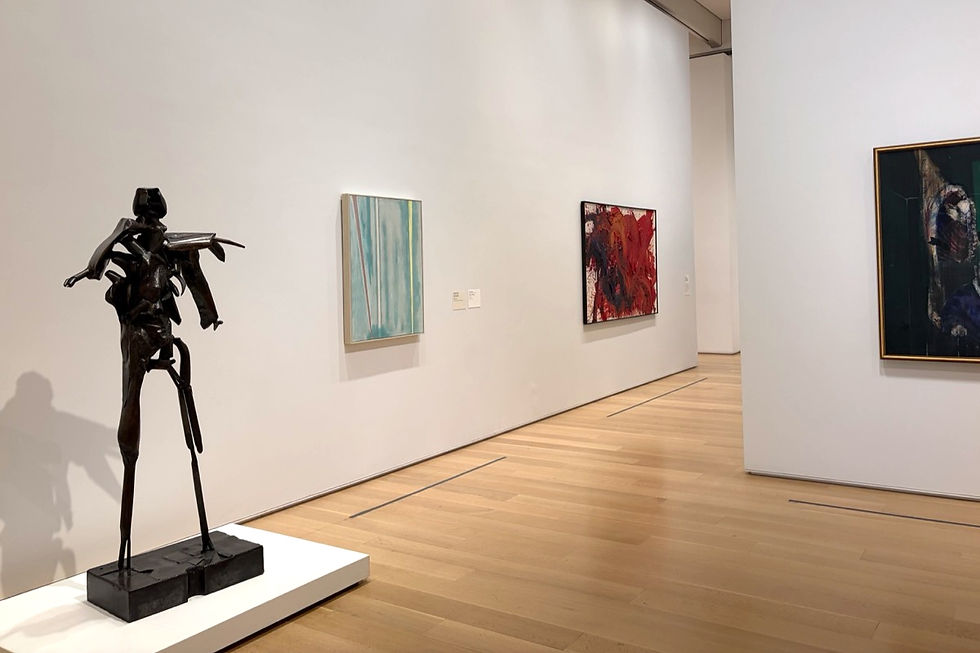
Richard Hunt's Hero Construction (1958) is a seminal early masterpiece of direct-metal sculpture, currently installed in the Contemporary Art Galleries at the Art Institute of Chicago alongside works by Jackson Pollock, Helen Frankenthaler, Francis Bacon, Philip Guston, and other masters. Welded after graduating from the School of the Art Institute of Chicago and completing a European traveling fellowship, the piece perfectly embodies Hunt's pioneering industrial salvage aesthetic. Utilizing the intense heat of his torch, Hunt masterfully welded together discarded automobile parts—including mufflers and steel pipes scavenged from local Chicago scrapyards—to create a resilient figure of heroism.
Standing in a defiant contrapposto stance, the work serves as a gritty, modernist response to classical statuary such as Michelangelo's David. However, rather than carving idealized marble, Hunt utilized the salvaged industrial materials of the 20th century to reflect on a hero and ask his audience the profound question, "What does a hero mean?". By reassembling these broken, industrial elements, Hunt suggests a new kind of modern champion—one intimately tied to his overarching themes of martyred heroism and African American struggle, particularly his ongoing internal response to the murder of Emmett Till in 1955. Hero Construction is a poignant accumulation of metaphorical will as one of the pieces in Hunt's Hero series, standing as a modest yet enduring symbol of resilience in the face of contemporary adversity.
Art after 1950
June 18, 2026 – Current

Kunstmuseum Basel

Kunstmuseum Basel

Kunstmuseum Basel
Kunstmuseum Basel
© 2026 The Richard Hunt Estate / Artists Rights Society, New York. Photo Courtesy Kunstmuseum Basel, Max Ehrengruber
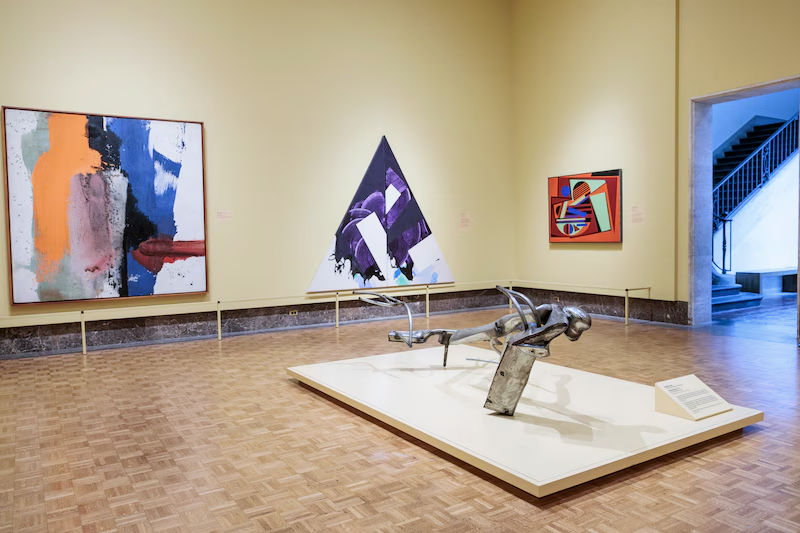
Kunstmuseum Basel has acquired Opposed Forms (1965), a landmark welded chromed steel sculpture by Richard Hunt, into its Abstract Expressionism collection. The work is now on view in the museum’s “Art after 1950” collections gallery, joining mid-century masters such as Clyfford Still, Mark Rothko, Franz Kline, and others.
Widely considered one of the most important American sculptors, Hunt spent seven decades transforming rigid, industrial materials into weightless, biomorphic expressions of growth and metamorphosis. The acquisition of Opposed Forms secures a pivotal, museum-scale work from the height of the artist’s mid-century career.
Reimagine African American Art
October 18, 2025 – Current
Detroit Institute of Arts
Detroit Institute of Arts
© 2026 The Richard Hunt Estate / Artists Rights Society, New York. Photo: Jacob Hamilton
For the first time since 2007, the Detroit Institute of Arts (DIA) is reinstalling its African American galleries to showcase new works in the DIA’s collection in concert with existing favorites. Reimagine African American Art highlights the DIA collection by moving the galleries to one of the museum’s most prominent spaces—directly adjacent to Rivera Court. This transformative reinstallation traces the development of African American art from the 1800s, when a few African Americans overcame tremendous challenges to become professional artists, to the 1980s, when some began to receive more national and international recognition.
Tracing the evolution of African American culture, the collection provides a powerful lens into the lives, achievements, and resilience of Black artists. Four dedicated galleries explore key historical movements, including the Harlem Renaissance, Social Realism, the Civil Rights era, and the Black Arts Movement. The reinstalled galleries feature a variety of media—drawings, prints, photography, paintings, and sculpture.
Richard Hunt's Field Section (1972) is the centerpiece of a modern gallery.
Contemporary Gallery Reinstall
April 9, 2021 – Current

Cleveland Museum of Art
Cleveland Museum of Art
© 2026 The Richard Hunt Estate / Artists Rights Society, New York. Photos Courtesy of The Cleveland Museum of Art
Currents and Constellations: Black Art in Focus puts art from the Cleveland Museum of Art (CMA)’s permanent collection in conversation with a vanguard of emerging and midcareer Black artists, as each explores the fundaments of art making, embracing and challenging art history. The connections between the artworks and the themes in this exhibition are best described both as currents, which are more predictable and easier to trace, and as constellations, which are less predictable and more difficult to follow.
Intimate in scale, yet broad in scope, Currents and Constellations illuminates singular works created by Black artists working in the United States to broaden visitors’ sense of Black artistic production. Richard Hunt's Firebird (1975) is included in the CMA's collection.
Swing Low, 2016

National Museum of African American History and Culture (NMAACH)

National Museum of African American History and Culture (NMAACH)
National Museum of African American History and Culture (NMAACH)
© 2026 The Richard Hunt Estate / Artists Rights Society, New York
Collection of the Smithsonian National Museum of African American History and Culture, Gift of Richard Hunt
Richard Hunt's Swing Low (2016) hangs proudly from the atrium ceiling in the National Museum of African American History and Culture. Hunt sees the arc segments in this hanging piece as a reference to the “swinging motion and wing-like forms” of the “band of angels,” made famous in the beloved Negro spiritual, Swing Low, Sweet Chariot. According to the artist, the piece pays homage to Negro spirituals, and “their defining place in early colored religious, social and cultural self-consciousness.”
Standing Form, 1961
Linear Spatial Theme, Number 2, 1962

Indianapolis Museum of Art

Indianapolis Museum of Art

Indianapolis Museum of Art
Indianapolis Museum of Art
© 2026 The Richard Hunt Estate / Artists Rights Society, New York. Photo Courtesy of the Indianapolis Museum of Art
Richard Hunt's Linear Spatial Theme, Number 2 (1962) has been on view at the Indianapolis Museum of Art since 2018. In addition, the museum acquired Standing Form (1961) in 2022. A close look at Standing Form reveals the bolts and other scrap Hunt incorporated into this work, elevating detritus to the level of fine art. Considered the foremost African American abstract sculptor, Hunt is known for works that incorporate unconventional media and allude to plant, human, and animal forms. A pioneer of welded sculpture along with Indiana native David Smith (whose work can be seen in the adjacent American galleries), Hunt scoured automobile junkyards for materials during the 1960s and transformed cast off automobile bumpers and fenders into elegant three dimensional compositions.
Slowly Toward the North, 1984

Crystal Bridges Museum of American Art

Crystal Bridges Museum of American Art

Crystal Bridges Museum of American Art
© 2026 The Richard Hunt Estate / Artists Rights Society, New York. Photos courtesy of Crystal Bridges Museum of American Art
Richard Hunt's Slowly Toward the North (1984), a sculpture on view in Crystal Bridges’ North Forest, commemorates the Great Migration, the large movement of Black Americans from the rural South to cities in the North from 1918-1970. The work combines two symbolically significant forms: a train and a push plow. The train form emerges from the steam locomotive’s driving wheels and front-end cowcatcher whose components present themselves prominently in the work. Viewed from the opposing side, the work recalls the forms of stylized handles, handlebars, plowshare and wheel of a push plow cultivator used by Hunt in the South when visiting family. The two primary elements point in opposite directions; the locomotive faces north, an allusion to the mode of transportation that brought many Black southerners to the industrial North. The plow points toward the agrarian South, representing the human labor (rather than animal or machines) used to till the earth.
Steelmakers
2025 – 2028

Griffin Museum of Science and Industry

Griffin Museum of Science and Industry

Griffin Museum of Science and Industry
Griffin Museum of Science and Industry
© 2026 The Richard Hunt Estate / Artists Rights Society, New York
Steelmakers explores the science and stories behind one of our most essential and versatile materials. Through hands-on experiences, a collection of wide-ranging artifacts and oral histories, this exhibit highlights how steel became an indispensable part of our modern world, contributing to expansive industrial growth and deeply rooted steelworker communities.
Richard Hunt's inspirations materialized from the industrial materials immediately around him in Chicago. On display in the exhibition is Hunt's Angle Form (1968), showcasing Hunt's master use of chromed steel in artistic form.